Gender Distribution

How was Indian research output distributed by gender based on first authorship?

Gender Distribution of Indian Research output

The Indian Research output during 2010 to 2019 was analysed to identify the gender distribution patterns. More precisely, the gender of the first author (leading author) for all the papers, has been determined using the Gender-API service. It is observed that only 29.3% of Indian papers are Female 1st authored, as compared to 70.7% Male 1st authored papers. The distribution of Female and Male 1st have remained almost the same during 2010 to 2019 period. The figure below shows the year-wise gender distribution of Indian Research output.
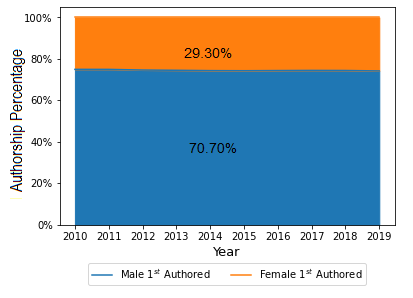
Gender Distribution of Indian Research output

Subject area-wise Gender Distribution

The gender distribution of Indian papers are also analysed with respect to different subject areas. While the majority of the 22 subject areas have almost similar percentage of Female 1st authored papers, subject areas like History & Archaeology, Built Environment & Design and Law & Legal studies have a slightly higher percentage of Female 1st authored papers. In general, only about one-fourth of the research papers in the majority of the subject areas have Female 1st author. The table below presents percentage of Female and Male 1st authored papers in different subject areas.
Citation statistics

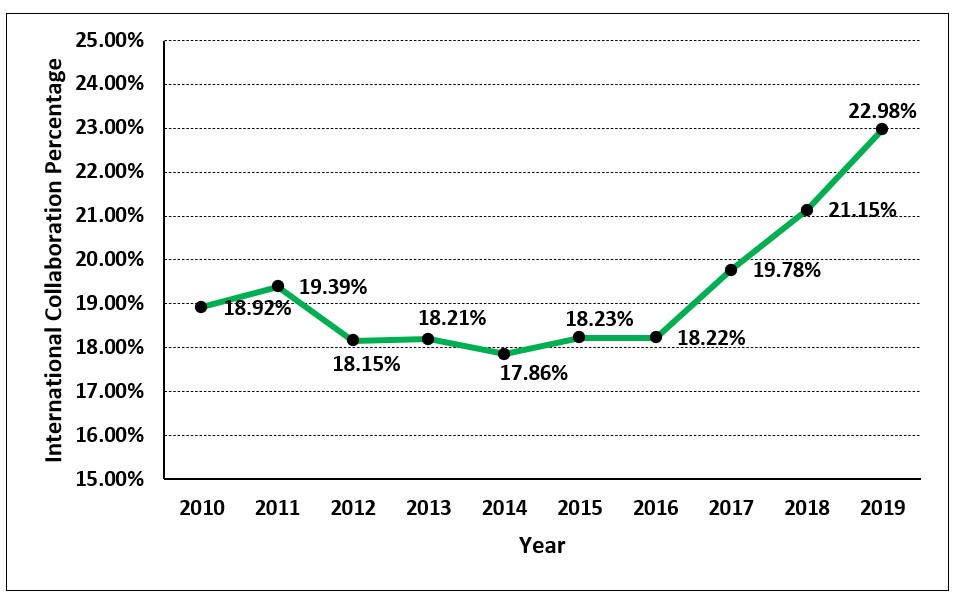
The amount of internationally collaborated papers from India are, however, lesser as compared to the 20 major countries. For example, United Kingdom has 48.73% of its research output that involves international collaboration. Similarly, France has 50.43%, Australia has 50.98%, and Switzerland has 65.63% of its research output, during 2010 to 2019, involving international collaboration. The table below shows international collaboration patterns of the 20 major countries considered.

Subject Area-wise Gender Distribution

Rank Subject Area Male 1st Authored Papers (%) Female 1st Authored Papers (%)

International Collaboration patterns in Female and Male 1st authored papers

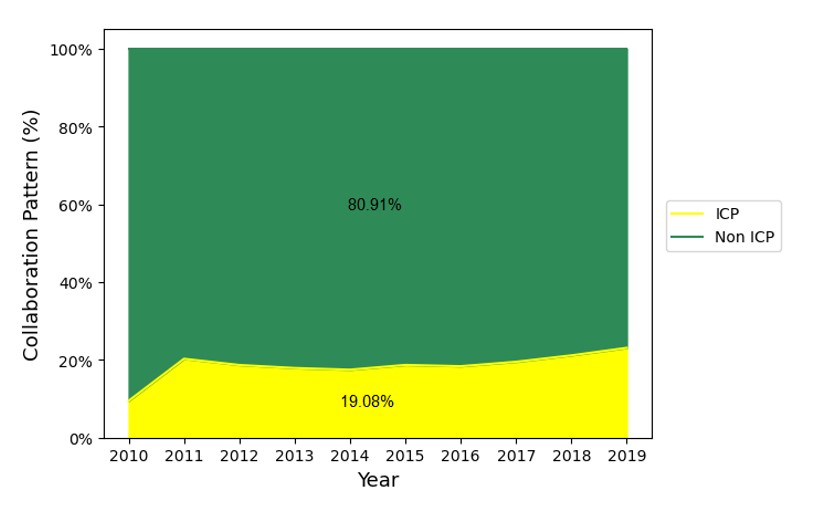
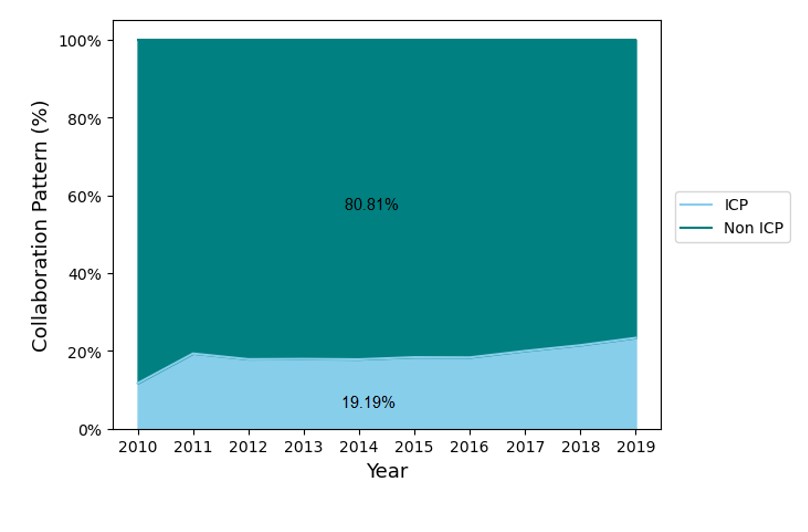
It was analysed whether there exist differences in the propensity for International Collaboration in Female and Male 1st authored papers. For this purpose, the proportion of papers that involve international collaboration in both the sets (Female 1st authored and Male 1st authored papers) were identified through the 'Country' information in the Author-affiliation field. It is observed that both Female and Male 1st authored papers have almost similar proportion of papers involving International Collaboration, with the International Collaboration Proportion in Female 1st authored publications increasing from 9.47% in 2010 to 23.08% in 2019 and International Collaboration Proportion in Male 1st authored publications increasing from 11.67% in 2010 to 23.34% in 2019. The figures below show the international collaboration patterns in Female and Male 1st authored papers.

Research output statistics
Global share of research output

Citation Impact of Female and Male 1st authored papers

The citation impact of Female and male 1st authored papers are analysed by computing the cited percentage (proportion of papers that attracted at least one citation) and Average Citations Per Paper for both the sets. It is observed that, in general, Female and Male 1st authored papers have similar cited percentage values during 2010 to 2019 period. Further, the Average Citations per Paper values of Female and Male 1st authored papers are also similar, with very minor variations. The table below shows the year-wise values of cited percentage and citations per paper for both Female and Male 1st authored papers.

Citation Impact of Female- and Male-First-Authored Papers

Year Female 1st Authored Papers Male 1st Authored Papers Female Citations per Paper Male Citations per Paper

Data Sources & Methodology

The above analysis and outputs are generated using data obtained from Dimensions and Altmetric (a part of Digital Science ).

Gender information was collected using the Gender API portal .